Carib Creek Project
- 100% owned 89 cells covering approx. 22sqkm .
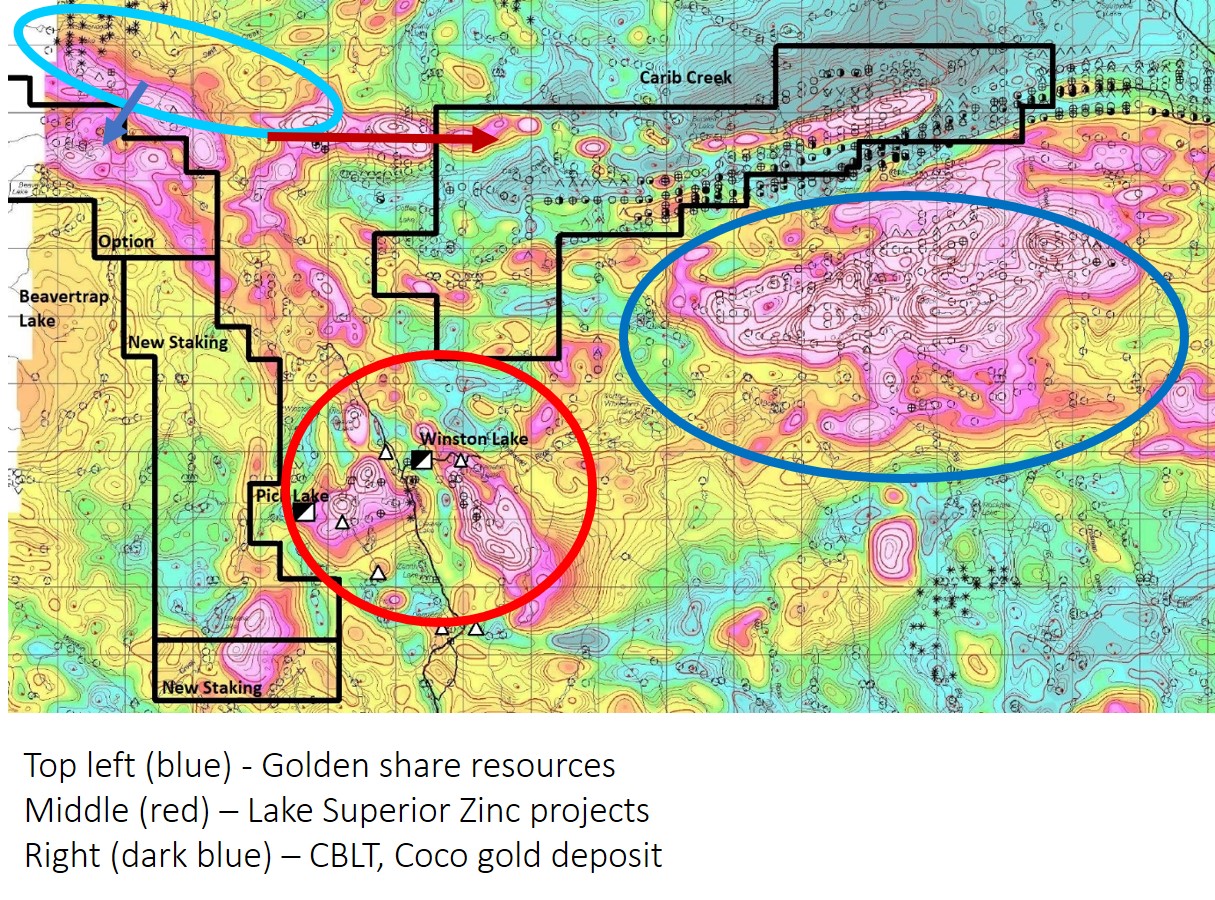
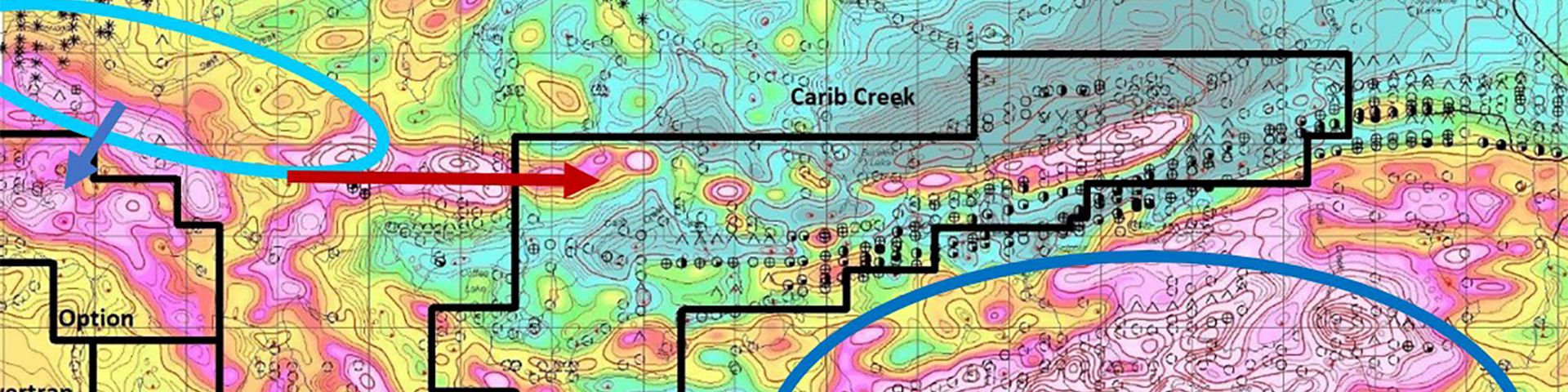
- Golden Share Resources prospecting and sampling identified 400m strike length in the Sandridge-Carib Lake area reporting more than 7% sulphides and Quartz veins and stockworks with up to 20% pyrite on a series of outcrops. The exact width of this zone is undetermined at present but it correlates well with an extensive airborne geophysical anomaly. This anomaly extends eastward through the north end of the Carib Creek property.
- Multiple high priority airborne mag and EM conductors exist within the property that have never been drill tested.
- Underexplored providing significant value growth potential.
- Large uptick in interest in the area with Metallum Resources acquisition of Lake Superior Zinc projects (a$16.5m and a$3.3 financing) with Sprott affiliated stakeholders.
- CBLT to the south is contemplating drilling the Coco deposit this year.
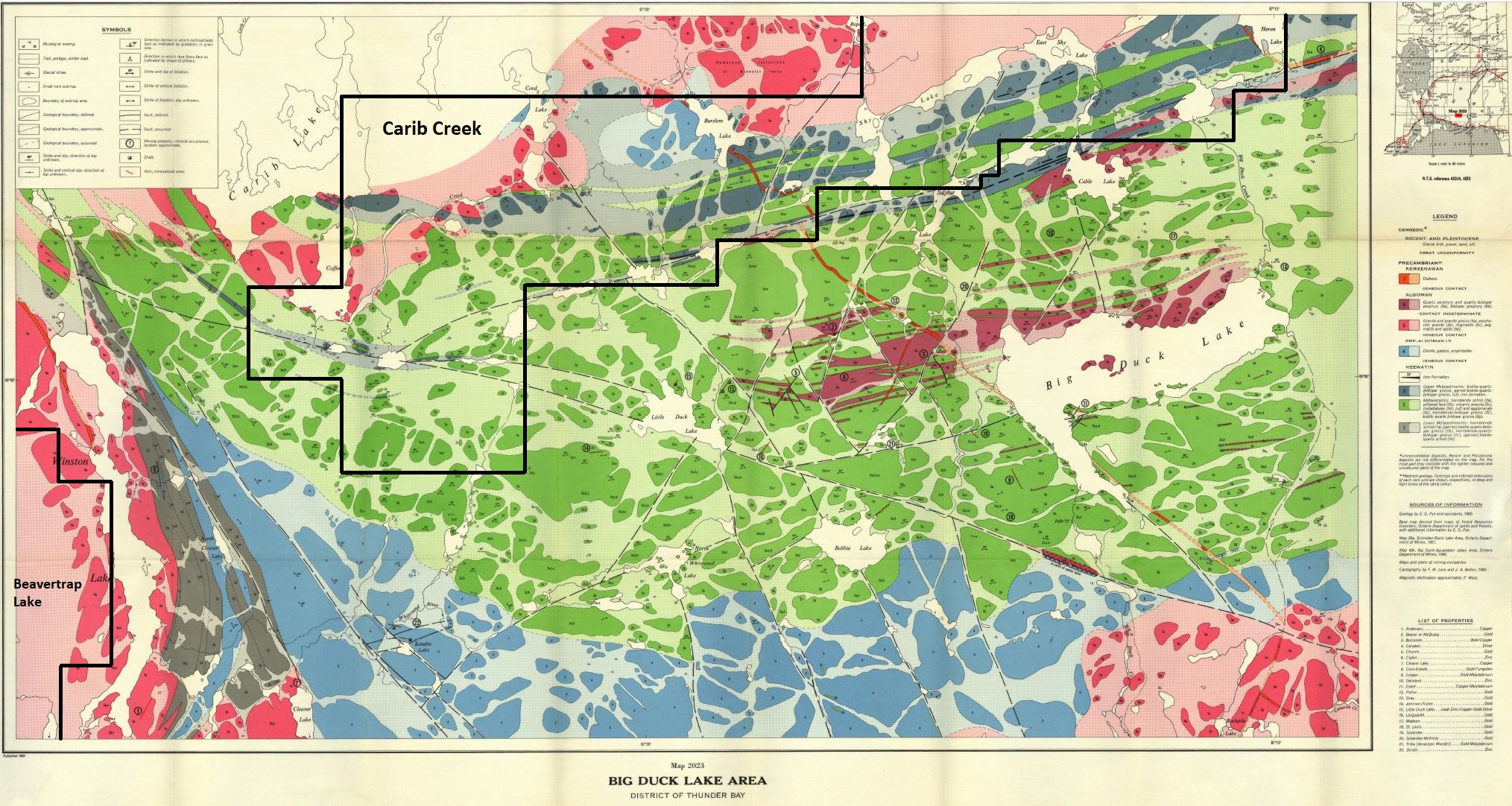
The 89-cell Carib Creek property is located within the northern Wawa terrane in the Archean Superior Province. It is hosted in the Winston Lake Greenstone Belt ("WLGB"), between the Shebandowan Greenstone Belt ("SGB") located to the west and the Manitouwadge Greenstone Belt ("MGB") to the east. All three belts are bounded to the north by the Quetico sedimentary terrane and host notable base metal past producers:
- SGB : Shebandowan mine, past production of 8 MT at 2.0% Ni, 1.2% Cu
- WLGB : Winston Lake mine, past production of 3 MT at 14.1% Zn and 1.0% Cu
- MGB : Geco mine, past production of 58 MT at 3.5% Zn and 1.9% Cu
The Carib Creek property lies one kilometer north of Pick Lake Mining’s past producing Winston Lake mine and Pick Lake Deposit.
Access to the south end of the property is via the Winston Lake Road. Access to the east part of the property is made by driving north on the Aguasabon Road for a distance 30 km north of the town of Terrace Bay and then by quad trail to the north end of Big Duck Lake.
The claims are underlain by a thick sequence of mafic massive and pillowed flows, minor clastic sediments, iron formation and coarse grained synvolcanic gabbroic sills. These sills are at times difficult to distinguish from coarser grained mafic flows. Felsic quartz-feldspar porphyritic rocks (QFP) intrude the above units. The stratigraphy strikes 250° to 270° and dips 65° to 85° to the north. Stratigraphic tops have been interpreted to be to the north.
A short distance south of the property lies a large QFP body situated along the north shore of Big Duck Lake. Numerous gold showings are associated with this QFP, including the high-grade Coco-Estelle gold deposit owned by CBLT Inc (53,700 tonnes grading 10.7 g/t Au). The Coco-Estelle Zone has many similarities to the Hemlo deposit, including the association of gold mineralization with sericitic and potassically altered QFP, the presence of a distinctive mineralized fragmental unit at the QFP-mafic volcanic contact, and the presence of green mica, molybdenite and unconfirmed reports of barite associated with the altered QFP.
Exploration for both gold and base metals in the Big Duck Lake area has been carried out intermittently since the discovery of the high-grade zinc deposit (Zenith Mine) in the late 1800's. W.H. Collins passed through Big Duck Lake in 1905 during his exploration of the area for the Geological Survey of Canada. Multiple gold showings were discovered in the area of Big Duck Lake between 1906 and 1914. The majority of recent gold exploration in the Big Duck Lake area has focused on the Coco-Estelle Zone located west of Big Duck Lake.
It is worthy to note that Metallum Resources are currently drilling Pick Lake to the south with the intent to put it back into production. Further, CBLT is contemplating drilling the Coco deposit this year. This activity will bring renewed interest in the area surrounding the Carib Creek property.
The Carib Creek property has undergone significantly less exploration than the Winston-Pick Lake southwestern domain and the Big Duck Lake southeastern domain. Multiple high priority airborne mag and EM conductors exist within the property that have never been drill tested. The potential for precious metal and base metal discoveries within the property is high.
It is worthy to note that Metallum Resources are currently drilling Pick Lake to the south with the intent to put it back into production. Further, CBLT is contemplating drilling the Coco deposit this year. This activity will bring renewed interest in the area surrounding the Carib Creek property.